DNA Codon Table and Amino Acid Chart
A codon is a group of three DNA or RNA bases. There are 64 possible codons: in the Standard Genetic Code, 61 of them encode amino acids and 3 are stop codons that end translation. The chart below lists all 64, with their RNA equivalents and amino acids.
Turn a name into DNA →All 64 codons
| DNA codon | RNA codon | Meaning |
|---|---|---|
| TTT | UUU | Phenylalanine (PheF) |
| TTC | UUC | Phenylalanine (PheF) |
| TTA | UUA | Leucine (LeuL) |
| TTG | UUG | Leucine (LeuL) |
| TCT | UCU | Serine (SerS) |
| TCC | UCC | Serine (SerS) |
| TCA | UCA | Serine (SerS) |
| TCG | UCG | Serine (SerS) |
| TAT | UAU | Tyrosine (TyrY) |
| TAC | UAC | Tyrosine (TyrY) |
| TAA | UAA | Stop |
| TAG | UAG | Stop |
| TGT | UGU | Cysteine (CysC) |
| TGC | UGC | Cysteine (CysC) |
| TGA | UGA | Stop |
| TGG | UGG | Tryptophan (TrpW) |
| CTT | CUU | Leucine (LeuL) |
| CTC | CUC | Leucine (LeuL) |
| CTA | CUA | Leucine (LeuL) |
| CTG | CUG | Leucine (LeuL) |
| CCT | CCU | Proline (ProP) |
| CCC | CCC | Proline (ProP) |
| CCA | CCA | Proline (ProP) |
| CCG | CCG | Proline (ProP) |
| CAT | CAU | Histidine (HisH) |
| CAC | CAC | Histidine (HisH) |
| CAA | CAA | Glutamine (GlnQ) |
| CAG | CAG | Glutamine (GlnQ) |
| CGT | CGU | Arginine (ArgR) |
| CGC | CGC | Arginine (ArgR) |
| CGA | CGA | Arginine (ArgR) |
| CGG | CGG | Arginine (ArgR) |
| ATT | AUU | Isoleucine (IleI) |
| ATC | AUC | Isoleucine (IleI) |
| ATA | AUA | Isoleucine (IleI) |
| ATG | AUG | Methionine (MetM)Common start |
| ACT | ACU | Threonine (ThrT) |
| ACC | ACC | Threonine (ThrT) |
| ACA | ACA | Threonine (ThrT) |
| ACG | ACG | Threonine (ThrT) |
| AAT | AAU | Asparagine (AsnN) |
| AAC | AAC | Asparagine (AsnN) |
| AAA | AAA | Lysine (LysK) |
| AAG | AAG | Lysine (LysK) |
| AGT | AGU | Serine (SerS) |
| AGC | AGC | Serine (SerS) |
| AGA | AGA | Arginine (ArgR) |
| AGG | AGG | Arginine (ArgR) |
| GTT | GUU | Valine (ValV) |
| GTC | GUC | Valine (ValV) |
| GTA | GUA | Valine (ValV) |
| GTG | GUG | Valine (ValV) |
| GCT | GCU | Alanine (AlaA) |
| GCC | GCC | Alanine (AlaA) |
| GCA | GCA | Alanine (AlaA) |
| GCG | GCG | Alanine (AlaA) |
| GAT | GAU | Aspartic Acid (AspD) |
| GAC | GAC | Aspartic Acid (AspD) |
| GAA | GAA | Glutamic Acid (GluE) |
| GAG | GAG | Glutamic Acid (GluE) |
| GGT | GGU | Glycine (GlyG) |
| GGC | GGC | Glycine (GlyG) |
| GGA | GGA | Glycine (GlyG) |
| GGG | GGG | Glycine (GlyG) |
Codons for each amino acid
Most amino acids have more than one codon. These synonymous codons usually differ only in the third base, so some single-letter changes in DNA leave the protein unchanged.
| Amino acid | 3-letter | 1-letter | DNA codons | RNA codons | Count |
|---|---|---|---|---|---|
| Alanine | Ala | A | GCT, GCC, GCA, GCG | GCU, GCC, GCA, GCG | 4 |
| Arginine | Arg | R | CGT, CGC, CGA, CGG, AGA, AGG | CGU, CGC, CGA, CGG, AGA, AGG | 6 |
| Asparagine | Asn | N | AAT, AAC | AAU, AAC | 2 |
| Aspartic Acid | Asp | D | GAT, GAC | GAU, GAC | 2 |
| Cysteine | Cys | C | TGT, TGC | UGU, UGC | 2 |
| Glutamic Acid | Glu | E | GAA, GAG | GAA, GAG | 2 |
| Glutamine | Gln | Q | CAA, CAG | CAA, CAG | 2 |
| Glycine | Gly | G | GGT, GGC, GGA, GGG | GGU, GGC, GGA, GGG | 4 |
| Histidine | His | H | CAT, CAC | CAU, CAC | 2 |
| Isoleucine | Ile | I | ATT, ATC, ATA | AUU, AUC, AUA | 3 |
| Leucine | Leu | L | TTA, TTG, CTT, CTC, CTA, CTG | UUA, UUG, CUU, CUC, CUA, CUG | 6 |
| Lysine | Lys | K | AAA, AAG | AAA, AAG | 2 |
| Methionine | Met | M | ATG | AUG | 1 |
| Phenylalanine | Phe | F | TTT, TTC | UUU, UUC | 2 |
| Proline | Pro | P | CCT, CCC, CCA, CCG | CCU, CCC, CCA, CCG | 4 |
| Serine | Ser | S | TCT, TCC, TCA, TCG, AGT, AGC | UCU, UCC, UCA, UCG, AGU, AGC | 6 |
| Threonine | Thr | T | ACT, ACC, ACA, ACG | ACU, ACC, ACA, ACG | 4 |
| Tryptophan | Trp | W | TGG | UGG | 1 |
| Tyrosine | Tyr | Y | TAT, TAC | UAU, UAC | 2 |
| Valine | Val | V | GTT, GTC, GTA, GTG | GUU, GUC, GUA, GUG | 4 |
Start and stop codons
Translation usually begins at ATG (AUG in RNA), which also encodes methionine. Because ATG also appears inside genes, not every ATG is a start codon: cells use nearby signals in the messenger RNA to choose where to begin.
Three codons — TAA, TAG, and TGA (UAA, UAG, and UGA in RNA) — are stop codons. They do not encode an amino acid; they tell the ribosome that the protein is finished.
| DNA codon | RNA codon | Meaning |
|---|---|---|
| ATG | AUG | Common start codon; encodes methionine |
| TAA | UAA | Stop codon — no amino acid |
| TAG | UAG | Stop codon — no amino acid |
| TGA | UGA | Stop codon — no amino acid |
The Standard Genetic Code is used by most organisms, but not all. Mitochondria and some microbes use slightly different codes — in human mitochondria, for example, TGA encodes tryptophan instead of stop. NCBI lists these variants as separate translation tables.
DNA codons and RNA codons
DNA and RNA use the same code with one letter changed: DNA contains thymine (T), and RNA contains uracil (U) in its place. When a gene is transcribed, the messenger RNA has the same sequence as the gene's coding strand, except that every T becomes U. That is why GCT in a DNA codon table and GCU in an RNA codon table both mean alanine.
- DNA
- ATG GCT AAA TAA
- RNA
- AUG GCU AAA UAA
- Protein
- Met Ala Lys Stop
The chart above lists both spellings, so it works with either kind of sequence.
DNA My Name's letter substitutions
These are site rules, not part of the genetic code. The 20 standard amino acids use 20 of the 26 letters of the alphabet. So that every name can be spelled, DNA My Name swaps each of the other six letters for a standard amino acid. This is a creative choice made by this site. In biochemistry some of these letters have their own meanings — U is selenocysteine, O is pyrrolysine, and B, J, X, and Z mark ambiguous or unknown amino acids — but none of them has its own codon in the Standard Genetic Code.
| Letter in a name | Spelled as | Amino acid |
|---|---|---|
| B | D | Aspartic Acid |
| Z | E | Glutamic Acid |
| J | L | Leucine |
| U | C | Cysteine |
| O | K | Lysine |
| X | G | Glycine |
Every other character follows a separate site rule. Spaces, digits, punctuation, accented letters such as é, emoji, and letters from other alphabets each become the placeholder codon AAA, which the Standard Genetic Code reads as lysine, so they appear as K in a name's amino acid sequence. This placeholder is not part of the genetic code.
Codon table FAQ
How many bases are in a codon?
Three. A codon is a sequence of three nucleotide bases, such as GCT in DNA or GCU in RNA, that specifies one amino acid or a stop signal.
How many possible codons are there?
There are 64 possible codons, because each of the three positions can be one of four bases (4 × 4 × 4 = 64). In the Standard Genetic Code, 61 codons encode amino acids and 3 are stop codons.
How do you use a codon table?
Split the sequence into groups of three bases, starting at the beginning of the reading frame, then look up each codon to find its amino acid. For example, ATG GCT AAA translates to methionine, alanine, and lysine. A stop codon (TAA, TAG, or TGA) marks where translation ends.
What amino acid does GCT encode?
GCT encodes alanine (Ala, A). In RNA the same codon is written GCU. Alanine has four codons in total: GCT, GCC, GCA, and GCG.
What does AAA encode, and is it a stop codon?
AAA encodes lysine (Lys, K). It is not a stop codon: the only stop codons in the Standard Genetic Code are TAA, TAG, and TGA. Because AAA contains no T, it is written the same way in DNA and RNA.
What are the start and stop codons?
ATG (AUG in RNA) is the most common start codon. It also encodes methionine within a protein, so not every ATG starts translation. The stop codons are TAA, TAG, and TGA (UAA, UAG, and UGA in RNA). They do not encode an amino acid; they signal the end of translation.
What is the difference between a DNA and RNA codon table?
Both show the same genetic code. A DNA codon table uses thymine (T), matching the coding strand of DNA, while an RNA codon table uses uracil (U), matching the messenger RNA that ribosomes read. For example, GCT in DNA corresponds to GCU in RNA.
Why can several codons encode the same amino acid?
There are 64 codons but only 20 standard amino acids, so most amino acids have more than one codon. These synonymous codons often differ only in the third base, as with GCT, GCC, GCA, and GCG for alanine. Only methionine (ATG) and tryptophan (TGG) have a single codon. This redundancy, called degeneracy, means some single-base changes do not change the protein.
Use the codon table
Spell a name in DNA
Type any name to see it written in real codons from this table. Shuffle swaps in synonymous codons while the amino acids stay the same.
Turn a name into DNAHow a name becomes DNA
Each letter becomes an amino acid, then one of that amino acid's codons is picked from this table.
Read how names become codonsChange one base
Mutate a single base in a name's DNA and see whether the protein changes: silent, missense, nonsense, or frameshift.
Try the Mutation LabTeaching codons?
A free printable worksheet has students translate a name into amino acids and codons, then explore codon degeneracy.
Open the printable worksheetDownload the codon chart
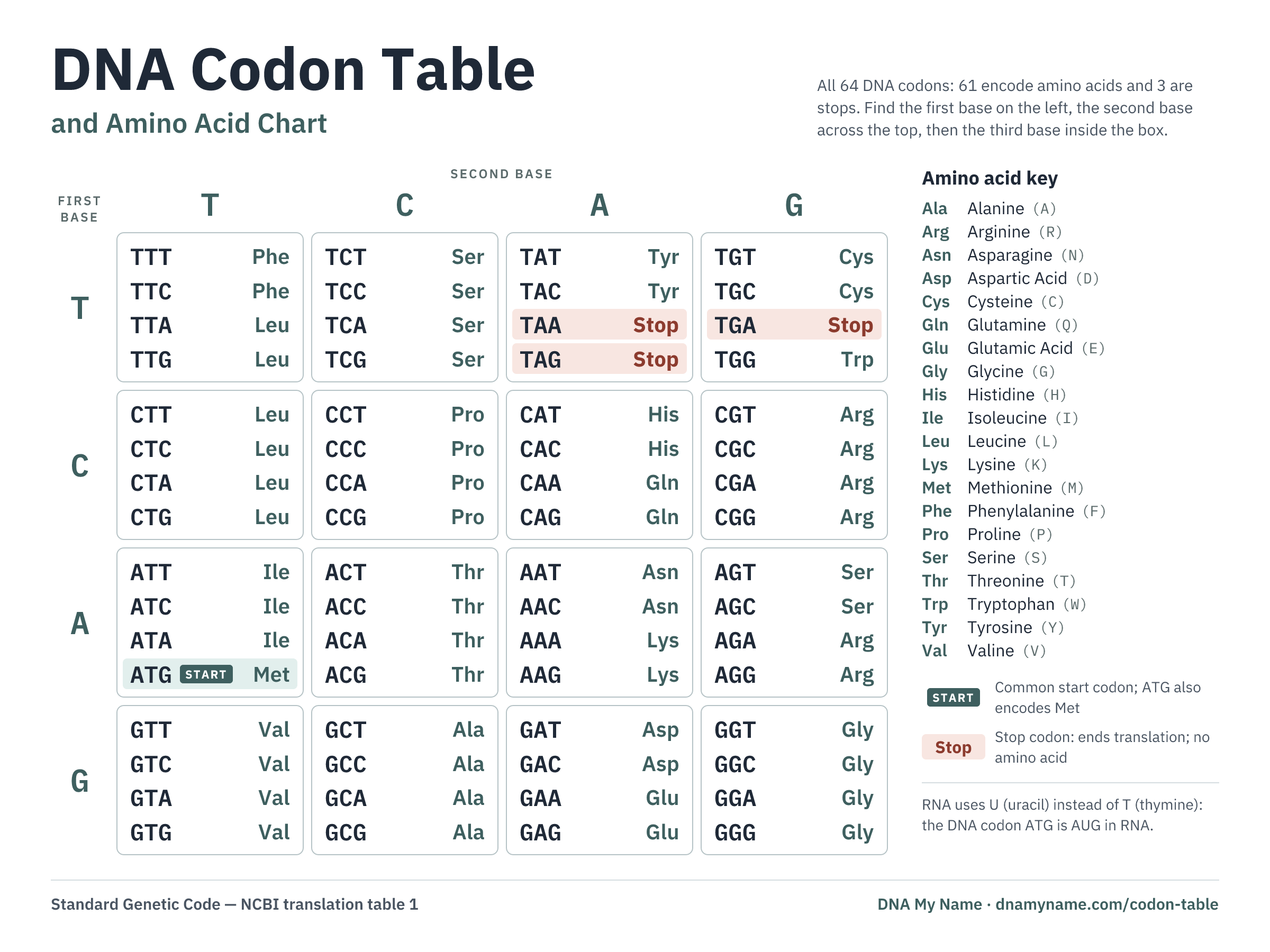
A printable DNA codon table for handouts, slides, and classroom walls. It arranges all 64 DNA codons by first, second, and third base and labels each with its amino acid's three-letter abbreviation or Stop. A key gives the full amino acid names, ATG is marked as the common start codon, and a note explains that RNA uses U in place of T.
Free to download for personal and classroom educational use. Please keep the attribution on the chart visible. To republish it, use it commercially, or embed it on another website, email feedback@dnamyname.com.
Suggested citation
DNA My Name, “DNA Codon Table and Amino Acid Chart,” dnamyname.com/codon-table. Data: NCBI Standard Genetic Code, translation table 1.
Sources and review
Standard Genetic Code assignments last checked against NCBI translation table 1 in September 2026.
Site-specific letter substitutions and placeholder rules are maintained by DNA My Name and are creative encoding rules, not biological standards.