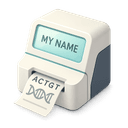
How DNA My Name Works
DNA My Name turns any name into a fictional DNA sequence — a name-mapping activity that uses the real codon assignments of the Standard Genetic Code. Here is the full pipeline.
Step 1 — Letters become amino acids
Each letter in your name is mapped to a one-letter amino acid code. The English alphabet has 26 letters but there are only 20 standard amino acids, so the six letters that are not amino acid codes (B, J, O, U, X, Z) are swapped for a standard amino acid chosen by DNA My Name: B→D, J→L, O→K, U→C, X→G, Z→E. These swaps are site rules, not part of the genetic code.
Every other character — a space, digit, or punctuation mark, an accented letter such as é, an emoji, or a letter from another alphabet — becomes the placeholder codon AAA. The Standard Genetic Code reads AAA as Lysine, so these positions appear as K in the amino acid sequence. Nothing is dropped or transliterated (é does not become e), and each character adds one codon, though some emoji are built from several characters. This placeholder is a DNA My Name rule, not part of the genetic code.
| Letter | Amino Acid Code | Full Name |
|---|---|---|
| A | A | Alanine |
| B | D | Aspartic Acid (substituted) |
| C | C | Cysteine |
| D | D | Aspartic Acid |
| E | E | Glutamic Acid |
| F | F | Phenylalanine |
| G | G | Glycine |
| H | H | Histidine |
| I | I | Isoleucine |
| J | L | Leucine (substituted) |
| K | K | Lysine |
| L | L | Leucine |
| M | M | Methionine |
| N | N | Asparagine |
| O | K | Lysine (substituted) |
| P | P | Proline |
| Q | Q | Glutamine |
| R | R | Arginine |
| S | S | Serine |
| T | T | Threonine |
| U | C | Cysteine (substituted) |
| V | V | Valine |
| W | W | Tryptophan |
| X | G | Glycine (substituted) |
| Y | Y | Tyrosine |
| Z | E | Glutamic Acid (substituted) |
Step 2 — Amino acids become DNA codons
Each amino acid is encoded by one or more three-letter DNA codons — this is the genetic code, one of the most conserved features of all life on Earth. For example, Alanine (A) can be encoded by GCT, GCC, GCA, or GCG.
This redundancy (called codon degeneracy) is why different shuffles of the same name still produce valid DNA: the same amino acid sequence is encoded, just using different synonymous codons.
DNA My Name uses the real genetic code — the same codon table used by textbooks and bioinformatics tools. See the complete DNA and RNA codon chart.
Step 3 — Deterministic codon selection
When multiple codons encode the same amino acid, the tool picks one deterministically using a seeded pseudo-random number generator (PRNG). The seed is derived from your name and a variant number using MurmurHash3. This guarantees:
- Reproducibility — the same name always produces the same DNA sequence
- Variety — different names usually produce different sequences
- Shuffle variety — incrementing the variant number changes the codon choices while keeping the same amino acid sequence
The PRNG is xorshift32, applied per codon position using the formula seed + position_index. This means every name position is independently seeded, preventing patterns from accumulating across the sequence.
What does “Shuffle” do?
Shuffle increments the variant number by 1. This changes the PRNG seed, which changes which synonymous codon is selected for each amino acid — but the amino acid sequence (and therefore the protein identity) stays the same. Think of it as choosing a different dialect to spell out the same biological meaning.
Is my result permanent?
Yes. Because the algorithm is purely deterministic and serverless, the same name and variant will always produce the same DNA sequence — on any device, at any time. There is no database. Share links encode all the information needed to reproduce the exact result.
Name to DNA questions
How do names become DNA sequences?
DNA My Name first maps each letter to an amino acid one-letter code, then maps that amino acid to a valid DNA codon. The final sequence is grouped into three-letter DNA words using A, T, G, and C.
Are the DNA sequences biologically real?
The codon mappings are real, but the generated sequence is a fictional model based on a name. It is useful for learning codons and amino acids, not for genetic testing.
What are amino acid one-letter codes?
Biologists often write amino acids as single letters: A for Alanine, G for Glycine, M for Methionine, and so on. DNA My Name uses those codes as the bridge between ordinary letters and DNA codons.
Why does Shuffle keep the same meaning?
Many amino acids can be encoded by more than one codon. Shuffle chooses different synonymous codons, so the DNA spelling changes while the amino acid sequence stays the same.
Scientific disclaimer
DNA My Name uses real codon biology, but the sequences it generates are not real genetic sequences. Real DNA encodes proteins with start/stop codons, regulatory regions, and introns. This tool is a creative educational experience, not a genetic analysis tool.
Sources and review
Standard Genetic Code assignments last checked against NCBI translation table 1 in September 2026.
Site-specific letter substitutions and placeholder rules are maintained by DNA My Name and are creative encoding rules, not biological standards.